SPECIAL COMMISSION ON COLLEGE AFFORDABILITY: “It’s not just a young person problem”
Plan highlights collaborative need to tackle affordability and degree attainment
AUGUSTA–Lawmakers, students, parents, and higher education leaders held a press conference today endorsing a collaborative 10-point plan to reduce higher education costs and increase degree attainment. The plan is the outcome of the Commission to Study College Affordability and College Completion.
“The issue of college affordability is an issue that spans beyond just being a ‘young person’s issue.’ It’s a concern for students of all ages, and their families. It’s a concern for the employers who lack a skilled workforce. And, it’s a concern for all of us, who want an economically prosperous state,” said State Senator Rebecca Millett of Cape Elizabeth, who served as the co-chair of the task force.
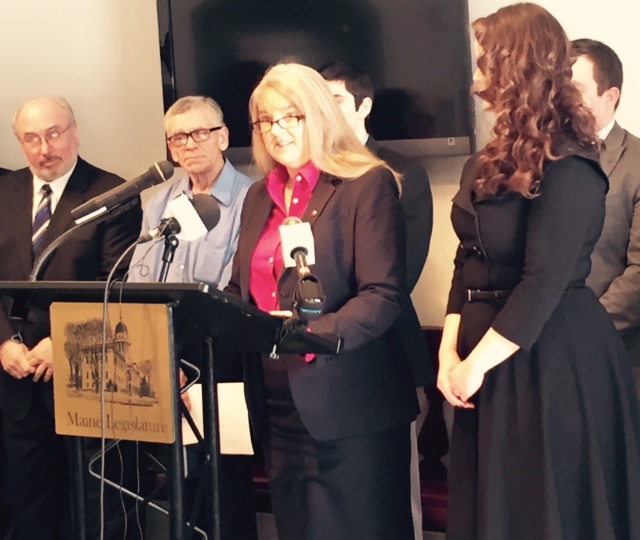
Sen. Millett at the press conference on college affordability
Statistics show that the average debt for Maine college students jumped 25 percent since 2008 to nearly $30,000–putting Maine at the 7th highest debt per student in the nation. According to the Federal Reserve Bank of New York and Liberty Street Economics report, student loan debt has surpassed credit card debt levels and the number of student loan delinquencies has risen.
Joey Blanchard, a student majoring in law enforcement at Central Maine Community College, spoke about the financial strain of paying for college. Blanchard works at a full time job and holds additional part time jobs while also pursuing a full courseload of studies at CMCC. In his remarks, Blanchard noted, “I’ve never allowed myself to think about dropping out of college. I know in order to some day work in law enforcement, I need to do whatever is needed to pay for college–and right now that includes mostly loans. I believe a college degree is the first step toward having the kind of life I want to have.”
“College debt is strangling my generation and it’s setting our state back. Mainers–and young Mainers in particular– are facing a quandary: more and more fields of employment require a college degree and yet many Mainers are unable to go into the careers they would like to due to the price of college,” said State Representative Matty Daughtry of Brunswick the co-chair of the Commission and co-chair of the Youth Caucus. “This is creating a chain reaction that, for the first time, could leave the next generation worse off than those who came before them.”
According to a report by Georgetown University and the Center on Education and the Workforce, young adults are reaching the middle class at a far slower rate than before. During the 1980s, young adults reached the middle of the wage distribution at an average age of 26; currently they don’t reach this point until age 30.
Erica Frederick-Rock, a 36-year old biology student at the University of Maine-Augusta, talked about her challenges with completing her degree after high school and in the process accruing more than $30,000 in student loan debt. She returned to school three years ago and is on track to graduate this Spring. She urged lawmakers to consider additional grant options for students.
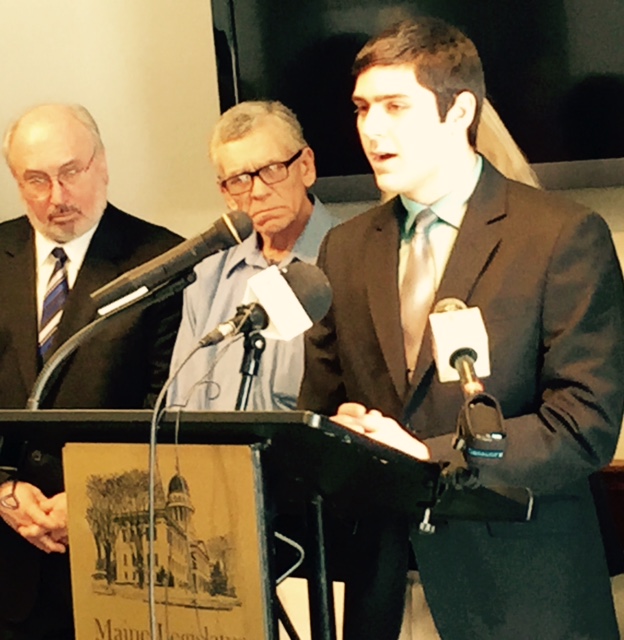
Joey Blanchard a student from CMCC speaks at the press conference
Richard Brown, a parent of a marketing student at Husson College, echoed Frederick-Rock’s sentiment: “My wife and I raised our son to know that if he works hard, he can succeed. I’m proud that he took these words to heart and is going on to earn his degree. But it hasn’t been easy on two fixed incomes. Thankfully the Maine State Grant has made a difference. Every dollar available has relieved us from some financial strain. I hope that the Legislature continues to support this program so that other kids can have the same chance my son has.”
Highlights of the Commission’s plan include:
-
Increasing the Maine State Grant Program from around $1,000 (roughly the same amount offered in 1992) to $2,500. Then to ensure timely degree completion, the grant will be structured on a tiered system that provides an additional $250 for each year a student is enrolled, up to five years;
-
Fully fund public higher education institutions in order to keep tuition low;
-
Increase transparency in college costs by having a published list of average class fees by majors for all Maine colleges and universities;
-
Encourage partnerships between higher ed institutions to develop open education resources, textbook coops, and free or reduced cost digital textbook options in order to help combat the rising prices of textbooks;
-
Adoption of the innovative “Game Changers” strategies from Complete College America by our state’s public institutions;
-
Setting specific degree attainment goals by the state and a plan to reach them.
The 13-member commission was created with the passage of LD 1849, “Resolve, To Establish the Commission to Study College Affordability and College Completion, during the 126th Legislature and included lawmakers and experts.They began their work last summer by meeting with students, parents, graduates, stranded learners, college representatives, financial aid representatives and key stakeholders from across the higher education landscape. The commission presented their final report for consideration to the Education and Cultural Affairs Committee this afternoon.
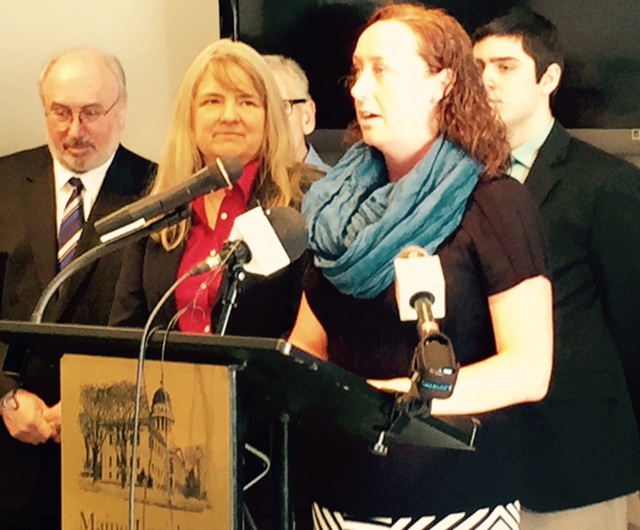
Erica Frederick-Rocks, a student at UMA, speaking at the press conference